High-intensity fundamental endurance?
A guide to using and thinking about basic endurance for people who are overweight.

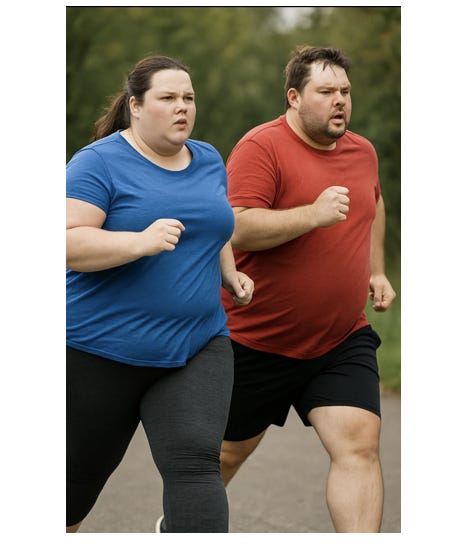
Yes, it's possible for some people to benefit fully from fundamental endurance training, provided they do it at a relative “high intensity”.
Yes, “Everything is relative, and this alone is absolute. - Auguste Comte, the father of sociology, for whom “the observation of facts is the only solid basis of human knowledge.” This is why the study of social facts, the object of sociology, requires familiarity with other sciences. Like the natural sciences, “social physics” must be able to establish invariable laws.
As a sports physiologist, I can only 👏 !
Indeed, we recently published an article demonstrating that overweight men and women over the age of 50 enjoyed the full benefits of training at Lipox max (the zone of maximum lipid utilization intensity in grams/minutes) AND increasing systolic ejection volume, which is the essential contributor to the increase in maximum oxygen consumption (VO2max) on the cardiac dimension of which oxygen intake. In short, people improve their VO2max, systolic ejection volume and lipid metabolism by having the profile of a top-level athlete with a lipox max zone close to VO2max.
So, if we go back to the standard clichés and criteria of fundamental endurance and its effects, we tick all the boxes, but the training is carried out at high relative intensity (in % of maximum aerobic speed and VO2max), quite simply because these overweight people can't run, and so their VMA is blocked at most at the walk-run limit (7-8 km/h depending on leg length and Froude number*).
In Anglo-Saxon literature, the terms Low-Intensity Training (LIT), Zone 1 (three-zone model), or Easy Pace (e.g. Daniels, 2013) are used to describe efforts comparable to EF. These efforts are located:
- at ≤ 75% VO2max and ≤ 80% of maximum heart rate (FCmax), i.e. ≈ 65-70% of heart rate reserve ;
-a blood lactate concentration ≤ 2 mmol-L-¹ ;
- a perception of effort (RPE, Borg scale 6-20) ≤ 12.
EF induces mainly peripheral adaptations:
Central adaptations (↑ systolic ejection volume, atrial and ventricular remodeling) are also reported, but occur mainly in highly trained subjects after several years of practice (George et al., 2011).
We obtained similar rapid results in overweight subjects in terms of cardiac output, with the following results, which Gepetto, who swallowed my article, summarizes as follows:
We can therefore see that, compared with the practical prescription recommended IN GENERAL (without taking any more interest than that in the person's profile!!), which is :
Heart rate: 65-80% FCmax or 60-75% of FC reserve (Karvonen method).
EPR: 10-12 on the Borg 6-20 scale.
Blood lactate: ≤ 2 mmol-L-¹ when available.
Speed: 60-70% of maximum aerobic speed (MAS) measured in laboratory or field.
Power: ≤ 70% of critical power for sports measured in watts (cycling, rowing).
On long sessions (EF sessions typically last 30 min to 2 h 30), we're talking about higher physiological and perceived intensities and much shorter durations, which can only be beneficial for the joints... especially when you have to pay the bill for all those ultra tricks of all kinds... The aim is to be a long-life ultra in top form, but that's another debate and a completely personal lifestyle choice!
References
https://www.researchgate.net/publication/391446534_Cardiovascular_Hemodynamic_and_Anthropometric_Adaptations_Induced_by_Walking_Training_at_FATmax_in_Obese_Males_and_Females_over_45_Years_Old#fullTextFileContent
Bassett, D. R., & Howley, E. T. (2000). Limiting factors for maximum oxygen uptake and determinants of endurance performance. Medicine & Science in Sports & Exercise, 32(1), 70-84.
Daniels, J. T. (2013). Daniels' Running Formula (3rd ed.). Human Kinetics.
George, K. P., et al. (2011). Athlete's heart: past, present and future. Experimental Physiology, 97(3), 319-343.
Laursen, P. B., & Jenkins, D. G. (2002). The scientific basis for high-intensity interval training: Optimising training programmes and maximising performance in highly trained endurance athletes. Sports Medicine, 32(1), 53-73.
Seiler, S., & Kjerland, G. Ø. (2006). Quantifying training intensity distribution in elite endurance athletes: Is there evidence for an “optimal” distribution? Scandinavian Journal of Medicine & Science in Sports, 16(1), 49-56.
Stöggl, T., & Sperlich, B. (2015). The training intensity distribution among well-trained and elite endurance athletes. Frontiers in Physiology, 6, 295.
* Why do we switch from walking to running? Because of the Froude number
1. Think of your leg as a compass
When you walk, your supporting leg behaves like an inverted compass:
The foot is the point, and your center of gravity makes a small arc above it.
The faster you go, the more force it takes to keep this “compass” glued to the ground without your foot taking off.
2. The “Froude number” is just a speed radar adapted to your height and gravity.
It's calculated as follows:
3. The magic threshold ≈ 0.5
In practice:
When Froude ≈ 0.5, walking becomes wobbly:
One would have to take tiny steps or turn the leg too fast;
The foot threatens to leave the ground;
The energy cost of walking exceeds that of running.
As a result, you naturally change your “locomotor mode” and start running.
Same Froude number, but very different speeds!
Things to remember
The transition from walking to running depends above all on the ratio between inertia and gravity, not on raw speed.
This ratio is captured by the Froude number, which is worth \~0.5 at the moment when walking ceases to be effective.
The longer your legs or the weaker your gravity, the lower your “critical” speed.
In short: when the energy it takes to “plant the compass” becomes too great, our body automatically switches to “spring” mode - running!
https://asepscience.fr/une-endurance-fondamentale-a-haute-intensite/